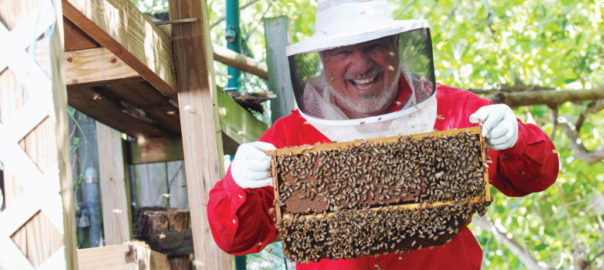
Photo by Aaron Bristol..bocamag
The ONE and Only,The ORIGINAL WillietheBeeMan, Bee removal Specialists, is known as one of the finest professional bee removal companies in Florida.
Bee Removal in these Florida Counties
Miami-Dade, Broward, Palm Beach, Monroe, St.Lucie, Martin, Indian River
Honest, Fast, Friendly, Effective Bee Removal Service
When possible we save the honeybees.
Complete Bee Hive Removal Done RIGHT the FIRST TIME
305 933 2337 561.571.2337 954.947.2337 772.800.2337
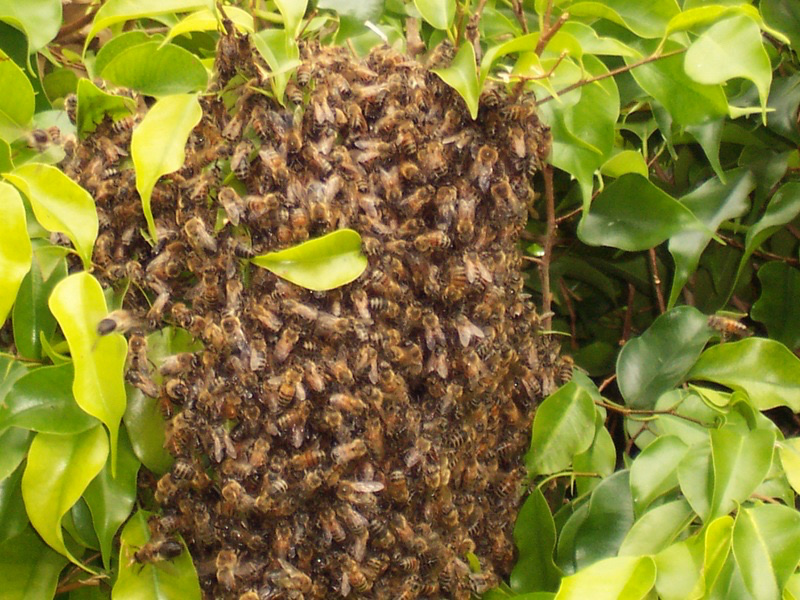
Swarming occurs several times per year here in Florida because of the favorable weather and the myriad locations in which bee hives can be secure. During swarm season, each hive splits when a new queen is born; the old queen and the new queen each have half of the bees from the hive, and both colonies then live, work, and make honey in two separate locations. Initially, bees don’t fly too far from their original hive, but Scout Bees find a location nearby for the swarm to rest. This cluster of 5,000 or more bees, land after swirling about, an awe-inspiring and even scary sight. Usually the bees form an elongated shape, such as that of an egg, football, or teardrop, but this is a TEMPORARY stop. This IS NOT where the bees will build their hive.
“What Do I Do When I Find a Swarm or Colony on My Property?
When a property owner encounters a swarm or an established colony, they have two options: have it removed alive or have it eradicated.
In some cases, depending on the size, location and temperament of an established colony, a registered Florida beekeeper can remove an established colony and all of its components (bees, comb, brood, honey) and relocate it safely to an apiary. Swarms, given their transient state and docile nature, usually can be removed easily and relocated to an apiary.
Eradication of a colony by a certified pest control operator is often the choice when the colony is nesting in a location that does not facilitate safe removal (e.g., high up in a tree, deep in an occupied dwelling, near a school, etc.), is deemed no longer able to thrive, or poses a stinging threat to humans.
It is important to note that it is the property owner’s choice concerning how a colony is removed. Although honey bees are an important agricultural resource, it is NOT illegal for a licensed pest control company to eradicate a nuisance honey bee colony. In some cases, public safety necessitates that a given colony be eradicated.
Never attempt to remove or eradicate nuisance bees or a colony yourself. It can be dangerous and, if not done properly, a violation of state or federal pesticide laws. “https://www.fdacs.gov/Consumer-Resources/Consumer-Rights-and-Responsibilities/Pest-Control/Bee-Removal-or-Eradication-in-Florida
AFRICANIZED BEES“Is it possible to tell an African honey bee from a regular or European honey bee by looking at it?
|





 .
.
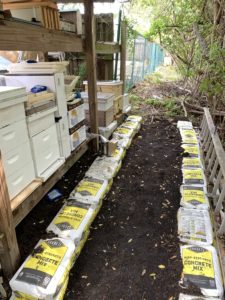


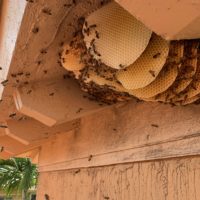
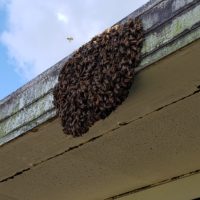
…..bee swarms on tree ……aerial beehive below soffit

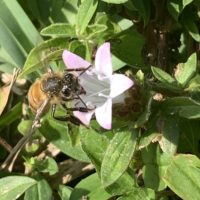


forager bees are workers with an age of over 21 days, tasks to collect water, nectar, pollen ….bees will forage up to seven miles, their last job.



Miami EcoAdventures Greynolds Park learning about bees.
Live Removal

Live Removals in nucs going to bee yard

Swarm of bees and colonies are found on branches, on tree trunks, in shrubs and bushes . on fences, on cars, airplanes, dog houses, sheds, pots, mail boxes, under soffits and many other places
Initially, bees don’t fly too far from their original hive, but Scout Bees find a location nearby for the swarm to rest. This cluster of 5,000 or more bees, land after swirling about, an awe-inspiring and even scary sight. Usually the bees form an elongated shape, such as that of an egg, football, or teardrop, but this is a TEMPORARY stop. This IS NOT where the bees will build their hive.
Though a huge ball of bees may be frightening, the entire swarm will usually fly away! Most swarms LEAVE WITHIN 72 HOURS and fly together, looking like a big black cloud, to a location found by scout bees, a place that is good for them to create a permanent hive.
So there they are… there’s a large number of bees on a tree in your yard or on the side of your house. They weren’t there yesterday…or, at least, you didn’t notice them. Money-saving tip: wait a day or so and see if they leave. If bees are in one location for days, weeks, months, or even years, and you want to eliminate the infestation OR if there is an emergency situation, such as proven medical reaction to bee venom or a high traffic area in a mall, you NEED bee removal by experts.We are THE EXPERTS you want!The ORIGINAL Willie the Bee Man has only highly-trained, experienced, knowledgeable, honest, professional technicians who WORK ONLY WITH BEES and BEE REMOVAL.
Successful BEE REMOVAL requires extensive training, an acute eye, and a delicate touch, because those honey bees need to be removed from your residential or commercial property. BEE REMOVAL can also be complicated, even huge, though most of the time, all you, the customer, will see is a dozen or so honey bees going in and out of a hole or crack somewhere on a building, house, or other structure. What most people don’t expect– and are surprised to find– is that right behind that tiny opening are thousands, or even tens of thousands, of bees, continuously building wax, making more and more deposits of honey, and protecting their colony INSIDE the structure,
that is, inside a wall, soffit, roof, ceiling, or other seemingly-impenetrable surface. Once the cavity is opened and we expose the hive, clients are amazed to find 50, 60, even over 100+ pounds of honeycomb filled with DELICIOUS raw honey and thousands of babies in the brood!
Proper BEE REMOVAL will usually require opening the cavity in which the bees are entering the building


whether it is a concrete block wall, a barrel tile roof, the bathroom ceiling, the playset floor, or the roof extension soffit on your property. State of Florida licensing assures you that the company is accountable for its work and that technicians acquire the continuous training and education required to give your situation the best possible safe and effective treatment.
Willie The Bee Man, Bee Removal Specialist guarantees that this bee infestation will be eradicated! Please note that there is NO deterrent chemical or process that can prevent other bees from establishing a colony on your property at another time. Engaging The Original Willie The Bee Man as your BEE REMOVAL specialists to rid your property of bees, you may be confident and comfortable knowing that our company is family owned and operated, and is fully licensed and insured.
For more information on Bee Removal Contact The Original Willie the Bee Man, Bee Removal Specialist at 305 933 2337, 561.571.2337, 954.947.2337, or 772.800.2337
Don’t clean it out, this might happen
After the colony is gone, we MUST REMOVE the nest. If the nest is NOT REMOVED, the wax combs — normally cooled by the bees — will melt and allow honey to flow down through the walls.Honey stain can never be removed; the walls will have to be replaced.
This is what happens when one does NOT do a complete bee hive removal
As well, the freed honey attracts robber bees and wasps and swarms. The comb wax will attract wax moths that may persist for several years. The Small Hive Beetle larvae tunnels through combs of honey, feeding and defecating, causing discoloration and fermentation of the honey.The dead bees will attract carpet beetles (not the ones that sing “Let it Be”) also the dead bees will decay and smell badly.
Bee Removal
Bees are an important part of pollination, not to mention the production of honey, but in or around your home they can be a painful nuisance. Especially if you have children, pets, or are allergic, a colony of bees is dangerous. The best and quickest way to achieve safe and effective bee removal is by calling , The Original Willie the Bee Man, Bee Removal Specialist at 305.933.2337 in Miami-Dade, 954.947.2337 in Broward, 561.571.2337 in Palm Beach and 772.800.2337 Saint Lucie County Cities
Bee colonies inside building
Different types of bees may affect different parts of your home, and all will fight fiercely to defend their nest. Carpenter bees chew individual tunnels, up to ten feet long, into wood. Bumblebees generally nest underground, but theymay choose to build nests around decks or patios or under roof beams. Bumblebees will chase an invader a long ways, and the pain of their sting may last for days. Honeybees prefer to nest in trees but may choose an attic or chimney as a nesting site. Honey bee colonies can be huge, sometimes reaching over one hundred pounds of honeycomb. The Original Willie the Bee Man, Bee Removal Specialist has the training, experience and equipment to effectively remove any kind of wasp or bee in Florida.
Invest in the best Bee Removal Specialists
Bee populations can be very large and their hives quite extensive. If they have decided to make their home within yours, a lot of labor and some deconstruction may be needed to remove them. To ensure that all bees are removed, it is often necessary to open the cavity in which the bees are living, whether your foundation, roof, or walls. It is imperative that the company you choose be licensed and insured, to ensure that damage to your home is minimal. A professional company will have the expertise and up-to-date knowledge to complete the work quickly and properly.
Choosing the right bee removal specialist will ensure that the job is done right the first time and that you, your family, and friends can continue feeling safe and comfortable in your own home and yard. If you have a bee problem, call 305.933.2337 in Miami-Dade, 954.947.2337 in Broward, 561.571.2337 in Palm Beach and 772.800.2337 Saint Lucie County Citiesand put my experience to work for you.
WILLIETHEBEEMAN. Supports


Please support your local NPR and Public Television stations at www.wlrn.org. WillieTheBeeMan is proud to be an Underwriter. We LOVE hearing from our customers, “I heard you on WLRN!”
WILLIETHEBEEMAN Supports
 v.
v. 



10th Year Galla
FRIENDS OF WILLIETHEBEEMAN

Florida Wildlife Control
http://www.247wildlife.com/orlandocritters.htm
Long Island Bee Removal
http://www.beeremovallongisland.com